HEC Approved in Y category Quarterly NOOR-E-MARFAT is a Religious Research Journal with a vision is to establish research-based Islamic civilization. Its mission is to quench the thirst for knowledge through mentoring researchers and publishing research papers. It is being published since 2007. It publishes the articles from Islamic perspective on Quranic sciences, Hadith (Tradition), Islamic jurisprudence, Principles of jurisprudence, Islamic history, Comparative religions, Education and Pedagogy, Divine literature, Divine Economics, Sociology, Islamic Political Thought, Iqbalogy (Iqbaliyat), Islamic culture and civilization, Islamic law and principles of law and so forth. It also publishes books reviews. The policy of the journal is to publish research-based articles that propose solutions to the intellectual and practical problems of modern era.
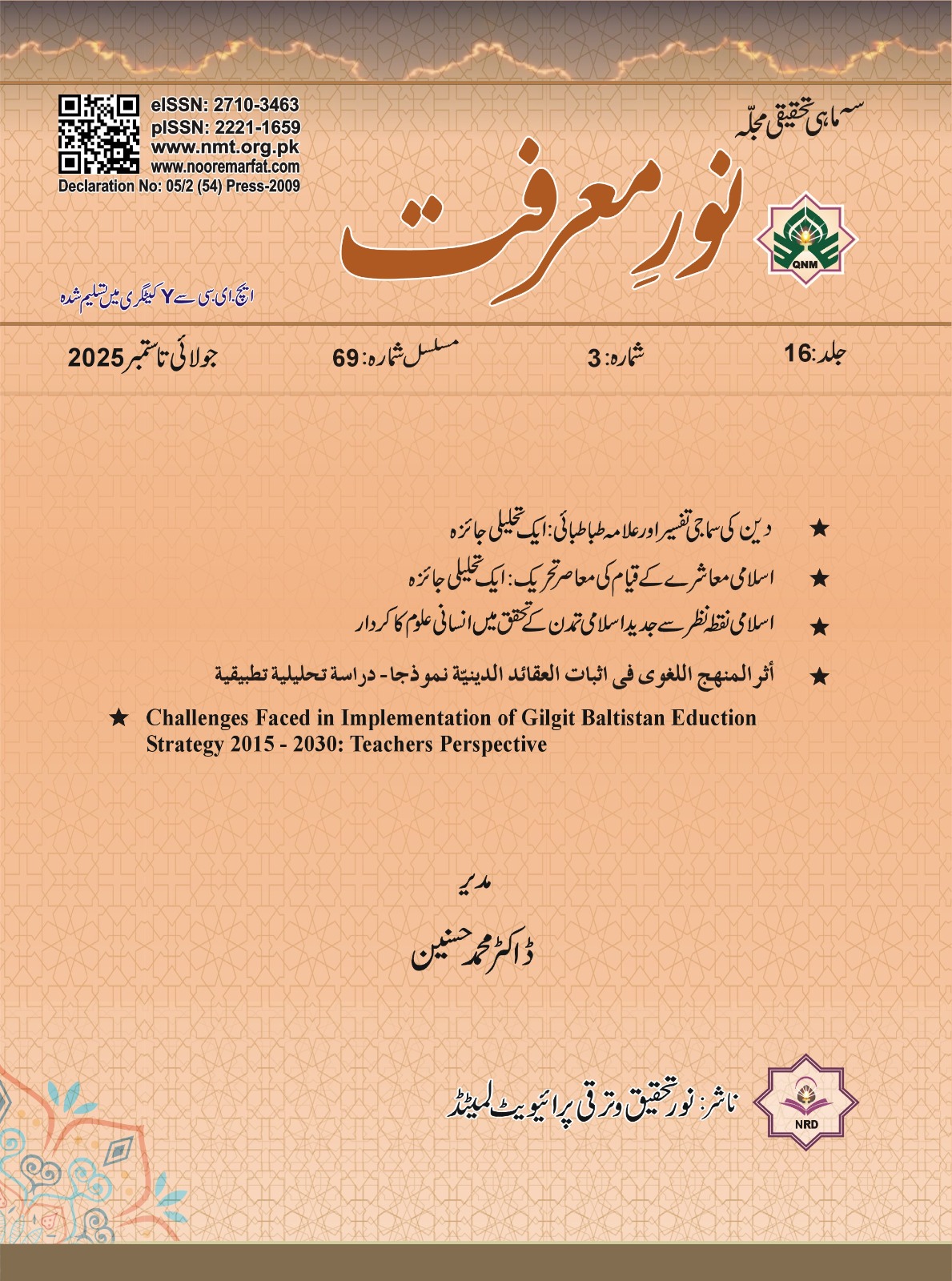
eISSN: 2710-3463
pISSN: 2221-1659
Frequency: July to September 2025
Editor: Dr. Shaikh Muhammad Hasnain Nadir
Current Issue
Vol 16 No 3 (2025): Quarterly Research Journal Noor-e- Marfat
The 69th issue of the quarterly research journal “Noor-e Ma’rfat” consists of five research articles, with given below core content:
The 1st article discusses the motivations of the contemporary movement for the establishment of an Islamic society, some excellent examples of this movement, and its positive and negative dimensions. This article also examins some important challenges that this movement may face.
The 2nd article attempts to clarify the way to strengthen the Islamic foundations of human sciences. According to this article, human sciences determine the direction of movement of individuals and societies. So, establishing these sciences on the Islamic concept of the universe is a campaign that will pave the way for the establishment of an Islamic civilization.
The 3rd article critically examines the ideas and thoughts of sociologists who consider religion to be a social phenomenon. Rejecting this viewpoint, the article contains an explanation of the ideas of Allama Syed Muhammad Hussain Tabatabai, according to whom the man’s nature is built upon religion; and social environment is just a necessary condition for the manifestations of religion.
The 4th article in this issue examines how the rules of language and expression, especially the rules of Arabic grammar and eloquence, are effective and involved in the affirmation and explanation of religious and Islamic beliefs from the basic textual sources. This article claims that the Shia Imamiyyah took special care to ensure that the general rules of Arabic grammar were fully adhered to in the expression and affirmation of religious beliefs. That is why Shia Imamiyyah were protected from personification of Allah almighty, his analogy, and quiddity etc.
The 5th article in this issue examines the challenges and difficulties faced in the implementation of the “Educational Strategy-2015-2030” for the promotion of education in Gilgit-Baltistan. This article explores the subject from the perspective of GB teachers and presents very useful and practical suggestions for overcoming the difficulties faced in the implementation of this strategy.
Full Issue

Editorials
Eng. Editorial
Dr. Hasnain Nadir Shaikh
Ed. (Urdu) اداریہ
Dr. Hasnain Nadir Shaikh
Articles
دین کی سماجی تفسیر اور علامہ طباطبائی: ایک تحلیلی جائزہ
The Social Interpretation of Religion and Allama Tabataba’i:An Analytical Review
Karamat Ali
اسلامی معاشرے کے قیام کی معاصرتحریک: ایک تخلیقی جائزہ
Contemporary Movement for the Establishment of an Islamic Society- An Analytical Review
اسلامی نقطہٴ نظر سے جدید اسلامی تمدن کے تحقق میں انسانی علوم کا کردار
The Role of Humanities in Realization of Modern Islamic Civilization from the Perspective of Islam
Syed Ali Rehber Jafri
أثر المنھج اللغوی فی اثبات العقائد الدینیۃ نموذجا دراسة تحليلية تطبيقية
The Impact of the Linguistic Approach on Proving Religious Beliefs: An Analytical and Applied Case Study
Muzahir Ali